AcreageTractorBook.com · Videos
Compact Tractor Without a Front Loader? Why It's Not Optional
 From Sam Trudou's video25 September 2026
A pile of gravel at the end of the lane and a quote for a tractor with no loader on it. Here are the five checks off the loader decision sheet that settle whether the loader belongs on that quote, and when to walk away.
The tool here is the loader decision sheet: eighteen lines, filled at the dealer, on the machine, off the dealer's printed page. Not from memory, not from an ad.
Start with the count. These are bucket jobs:
- Move gravel.
- Pick up a fallen limb.
- Carry a pallet of seed to the barn.
- Push snow off the turnaround.
- Set a post.
If four of your eight jobs put something in a bucket, the loader is the machine and the tractor is what carries it. Eight jobs is the book's working length, and the book labels it an assumption.
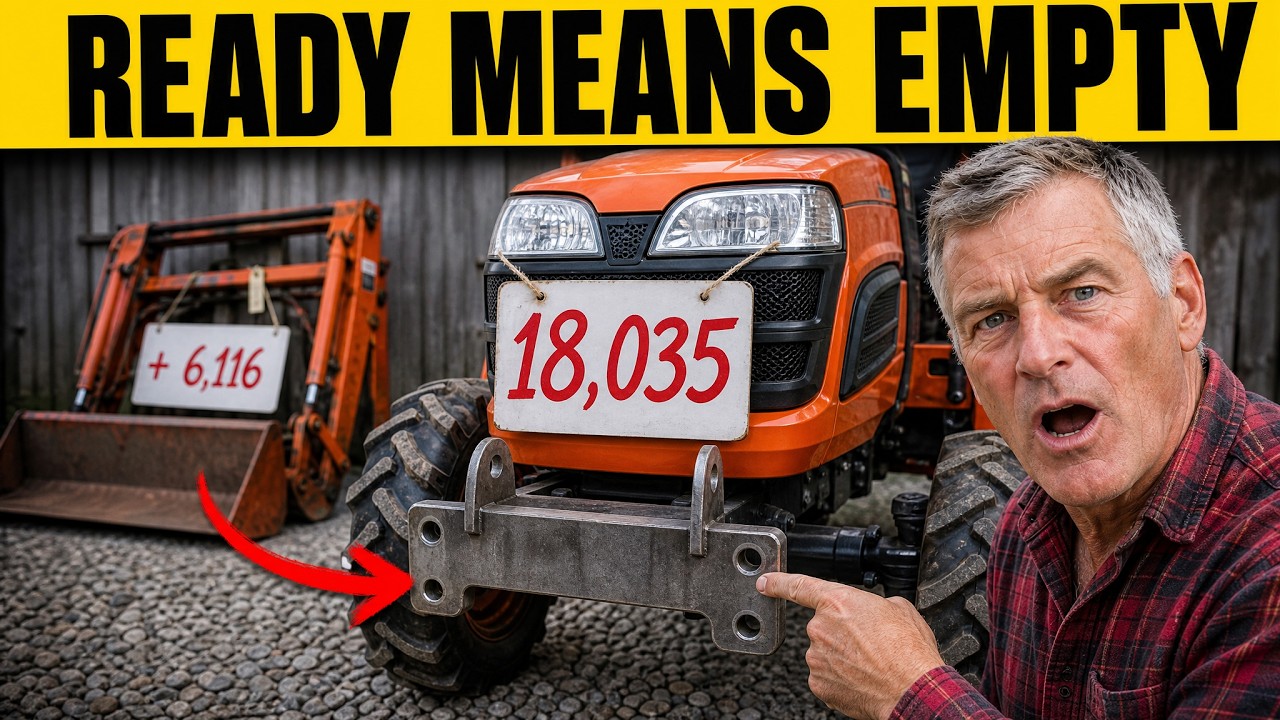
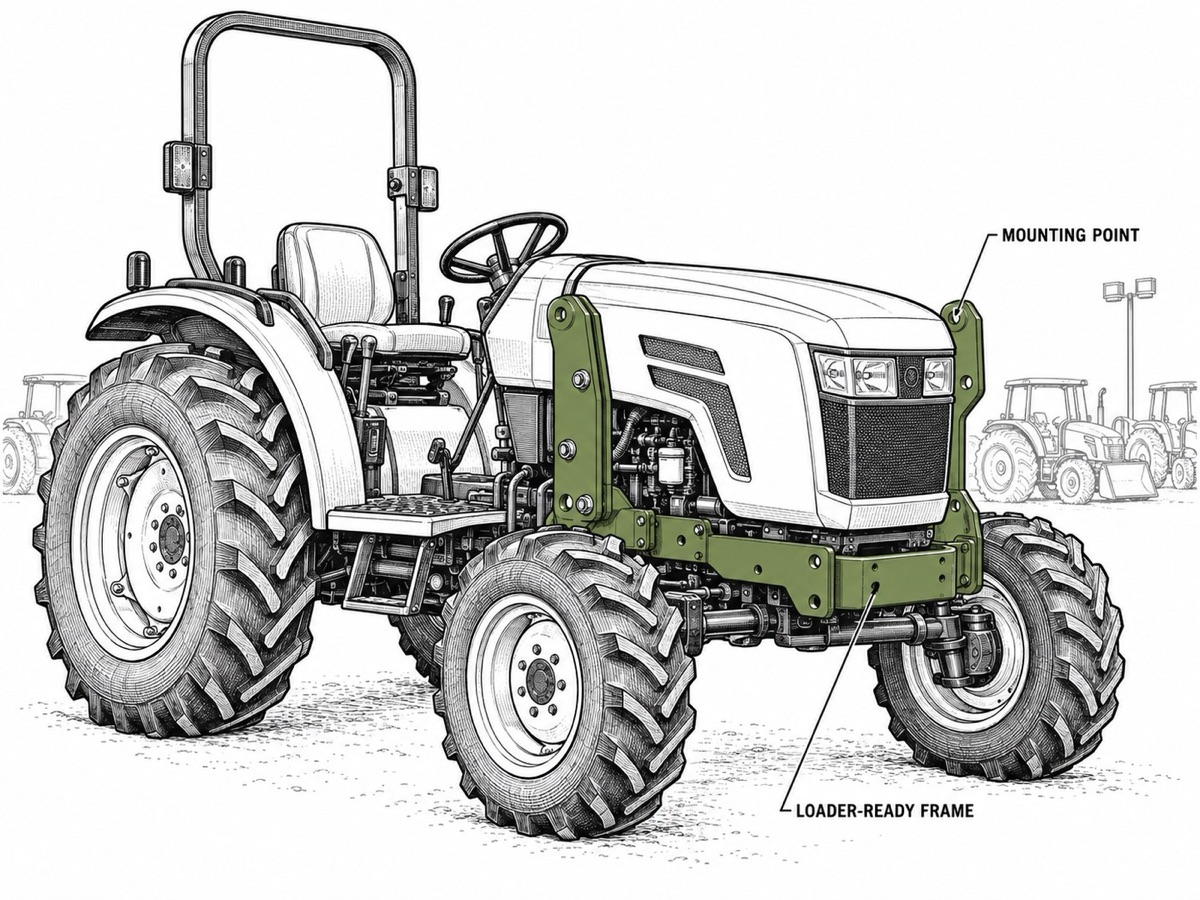
Lots sell it the other way around. The loader arrives as an option code near the bottom of a sheet, or as a phrase in an ad, or as one word: ready. Loader ready means a mounting frame and nothing to mount. So a loader-ready quote, when four of your jobs need a bucket, is a machine that cannot do half your list on delivery day. Every brand sells frames and loaders as separate lines. No brand is the enemy here. The adjective is.
Check 1. Count the bucket jobs
Go down your eight jobs, mark yes or no on every row for whether it puts something in a bucket, and total the yeses.
That total sits at the bottom of the sheet, and it is the box I fill first, before I look at a horsepower number. Four or more out of eight and the loader becomes the reason for the purchase.
Check 2. Ready is not installed
Make the written quote name the loader by its model, then look for that loader on the machine before the truck leaves.
One manufacturer sheet shows the arithmetic. John Deere's commercial price page, code 028NLV, is dated November 4, 2022. It is four model years stale and a contract list, not your quote. On it:
- The base machine, a sub-compact utility tractor, at $18,035.
- The factory installed loader with bucket, a separate code, 1710, at $6,116.
- Directly under that, code 1795: Less Loader, In Base Price.
The base price is already a tractor without a loader, so going without adds nothing and takes nothing off. The loader is additive. $18,035 plus $6,116 is $24,151, before deck, ballast, freight or tax.
So the delivery-day surprise is four figures, and it is handed to you inside one adjective. Ready is a frame. Installed is a loader.
Check 3. Ballast, in writing, by code
Ask for the ballast line items by code on the written quote, then read the ballast section of the operator's manual before the first load.
The company that built both ends of the machine printed the requirement on the sheet that sells the loader, word for word: "Three-Point Hitch Ballast is Required for Stability. Please Review the Tractor Ballast Requirements in the Sales Manual for Proper Ballasting." Required. For stability. Not recommended. Kubota's BX23S page says the same in its Land Pride copy: proper ballast is essential for safe operation.
The mechanism is plain. A loaded bucket out front lifts weight off the rear tires. Light rear tires steer badly, brake badly, and on a slope they do worse than that.
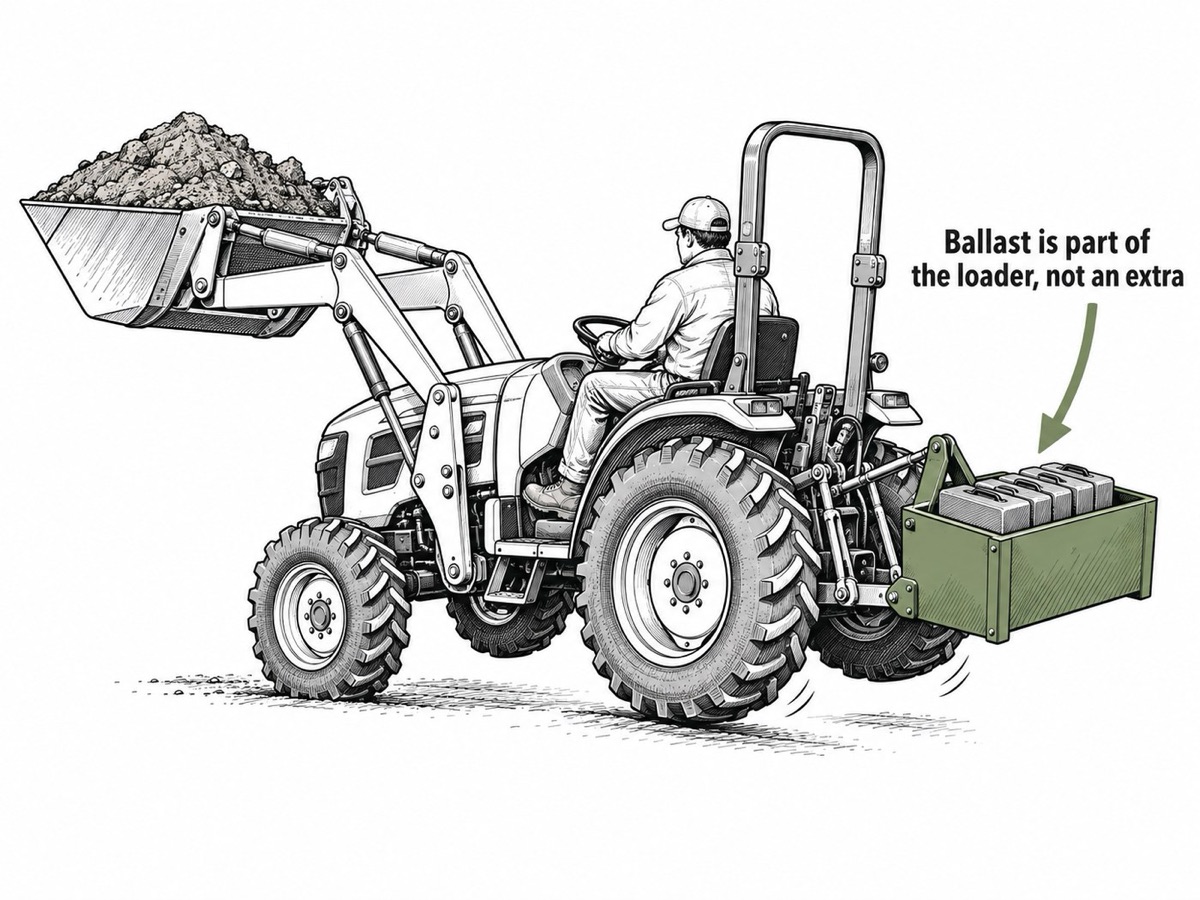
On that same 2022 list a ballast box is its own code at $547.30. How much weight, and where, is in the operator's manual and on the capacity plate, and those outrank this page and the salesman. A dealer who sells you the loader and no ballast has sold you the half of the system that goes up.
I would not sign a quote with a loader on it and no ballast line underneath. Make the dealer write the codes down.
Check 4. Name the coupler
Write the coupler name exactly as the dealer sheet prints it, then photograph the coupler face and both loader pins before you drive.
Two things get called quick attach: how the loader mounts to the tractor, and how the bucket mounts to the loader.
Pin-on means pins you knock out with a hammer and a drift. There is less to wear out, and changing to forks means lining up holes by feel, alone, in the mud. Owners with pin-on buckets quietly stop changing the attachment. The forks stay in the shed.
Quick-attach means a coupler plate with levers. The catch is that no source in The Acreage Tractor Decision Book defines one quick-attach standard across brands. One maker's page for one subcompact, Kubota's BX23S, names the coupling four ways:
- A two-lever quick attach on the bucket.
- Universal Quick-Attach on the forks and grapples.
- A Kubota BX Quick-Hitch System on a snow pusher.
- A claw grapple that fits only the BX80 with two lever hitch plates.
One model, four names. So do not write the words quick attach on the sheet. Write the name the paperwork uses, and carry the photograph home in your phone. Two couplers that both say quick attach can refuse to mate.
Check 5. Two lift numbers and one weight
Copy lift at the pin, lift at 500 millimeters and the tractor's operating weight off the printed sheet, with its model year.
A rating appears in more than one place, because lifting at the pivot pin and lifting at arm's length are different jobs. The second figure is smaller, and it is the one that matches how you work, because the material sits out in front of the pin.
Deere's page for the 120R loader prints both: 803 pounds at the pivot, and 553 pounds 500 millimeters ahead of it, at full height, on a tractor its own table names as Model 2025R, 2026R. Two numbers, 250 pounds apart. The same page lists the loader as fitting the 1025R while printing no 1025R lift line at all.
The book prints no lift figure for your machine, because a number reprinted wrong is worse than no number. Weight, ballast and lift are one system.
One model name can also split in half on price. As of September 2026:
- One dealer listed a 2026 John Deere 1025R with 120R loader and quick coupler at $31,599, against an MSRP of $33,485.
- Another listed a 2026 1025R starting at $23,610.
Verify both at the dealer. Nearly eight thousand dollars sits between them, and that gap is not a discount you failed to ask for. One price is a machine with a loader on it. The other is where that dealer's list begins. Put them side by side and you have compared nothing.
When a dealer says a price, I ask two questions before anything else: is the loader on that, and is the ballast on that?