AcreageTractorBook.com · Videos
Used Compact Tractor Red Flags: Hours, Loader Pins, Wet Brakes
 From Sam Trudou's video28 September 2026
A used compact comes with a price and a story, and only the price is written down. Here are the five checks you run with your own hands before money moves, in the order you run them, and the findings that send you home.

The price is on the ad. The story is the part that costs money, and it is the only thing in the sale nobody has to prove. The ask was written against it. Kubota, Deere, Mahindra, LS and TYM are examples here, never a team.
Used is not the wrong answer. A well-kept machine with a loader mounted, forty minutes from a dealer who stocks its filters, is the best buy in the book. It is wrong only when it is bought on a price and a feeling.
There is no fair price per hour. The book prints none, because nobody publishes a depreciation curve for compacts. Write a dated new price beside the ask instead: as of September 2026, Kubota's series page for the BX23S read MSRP as low as $28,061. Verify at the dealer and on the plate.
What turns the rest into evidence is the on-lot used card: six rows, pass or fail, and a column for what you saw, filled standing up in the printed order. The order keeps you honest once you like the machine.
Check 1. The meter against the wear
Read the meter yourself with the engine running, then put your hand on the seat, the pedal rubber and the steering wheel rim.
A number typed into an ad is not a reading. Those three places are where hours actually show.
A low reading with a worn-through seat and a pedal rubbed smooth does not match. The check fails when the machine looks older than the number. Ask, and watch the answer.
Then the number everybody carries in their head: 500 hours. The book labels it an assumption in print: a common asking point, not a measured wear threshold, and in no manufacturer table. Use it to sort listings, never to approve a machine.
Hours only mean something next to the work. The same reading can come from mowing turf or from loader work on gravel.
Check 2. Loader-pin play
Bucket down, engine off, take the bucket edge and work it side to side, then watch each pin while he crowds and dumps.
A foot off the ground is high enough. Look for:
- A pin moving inside its bore
- A hole gone oval
- A bright ring of fresh metal at the joint, which is movement that happened recently
If the play shows from a standing position, without a light or a creeper, that is a walk. Not a discount, not a maybe. It is wear in the part you came to buy, and still not the worst thing under this tractor.
Check 3. Wet brakes
Engine off, key out, parking brake set, get low behind the machine and run your fingers around the rear housing, both sides. Then look at the ground where it has been parked overnight.
This is the check that can end the visit, and I would run it before the test drive, not after. Kubota's detailed specification for the BX23S lists the brakes as mechanical, wet disc type. Deere's commercial price page lists wet disk brakes. On both, the discs run in the transaxle oil, the same sump the transmission uses.
So grade the finding:
- A damp film at an axle seal is common on a used compact, and it is not proof the brakes are done.
- Oil running down the housing is a different finding.
- So is a patch on the ground that builds overnight.
- On the drive, the brakes either hold or they do not.
This page cannot tell you what is leaking: a seal, a gasket, a case, a line. It cannot tell you the cost either, because no source in the book prices it, and it will not guess.
Your decision is simpler than the diagnosis. Oil running at the housing, or brakes that will not hold, and you leave. A damp seal is not a walk, and not a shrug. It is a shop quote, in writing, before money moves.
A 500 hour tractor with oil running at the brakes still walks. The meter does not outrank the housing.
Check 4. The three-point and the shield
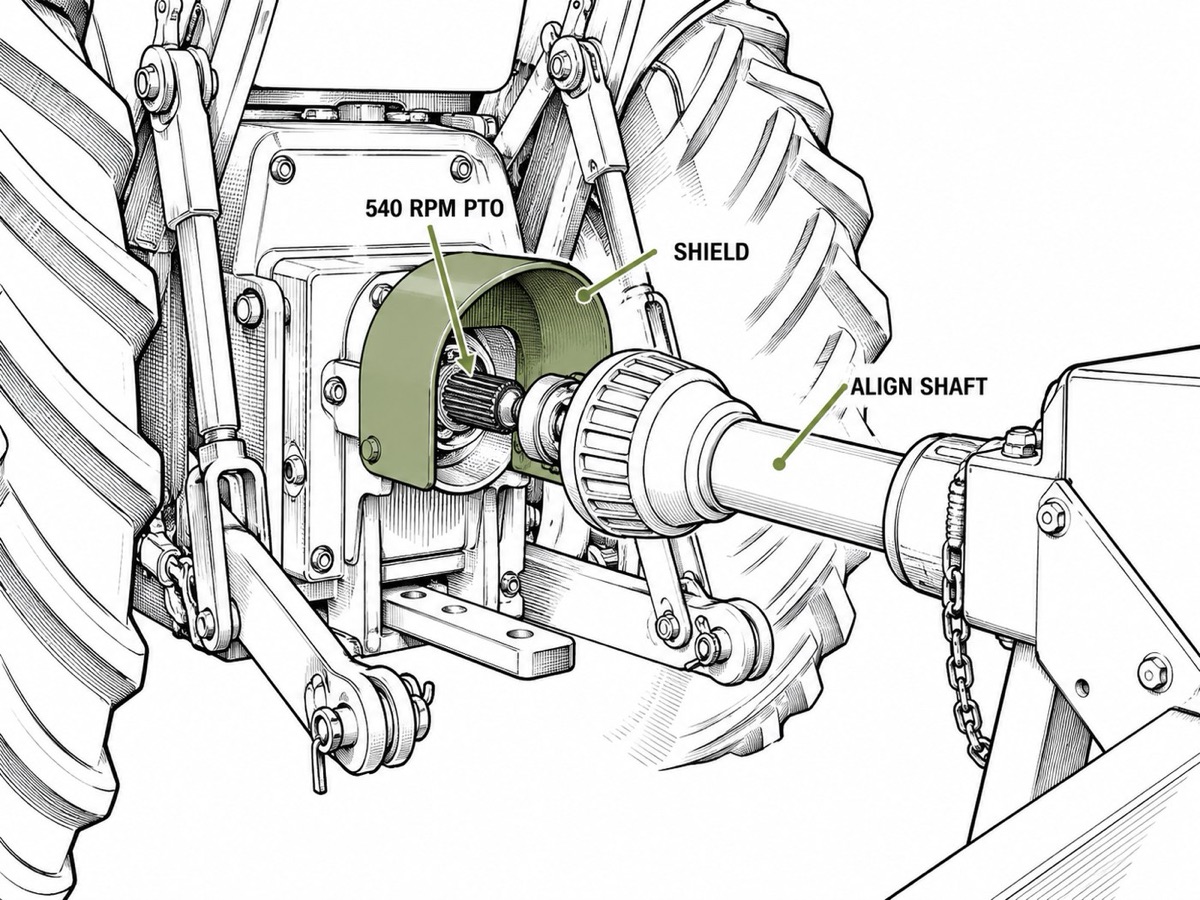
Put both lift arms in your hands, then lift the PTO shield and look at the splines.
Two printed lines tell you what you are holding. Kubota's sheet gives the BX23S rear PTO as SAE 1-3/8, 6 splines, standard 540 rpm, and the hitch as SAE Category 1. Deere's prints a 540 rpm PTO with a flip-up shield. Those are the lines an implement seller needs from you. Then the splines themselves: square, or rounded from wear you would inherit.
Then the shield. A missing PTO shield, a missing or modified roll bar, or a missing seat belt is a machine you walk away from. Those are not accessories.
The federal agricultural tractor rule, 29 CFR 1928.51, covers tractors made after 25 October 1976 and requires a rollover structure on employee-operated machines, with a belt tight enough to hold the operator inside the protected zone. That is an employer and employee rule, not a statute about a landowner on his own ground. Read it as the standard the hardware was built to.
Kubota calls its structure a factory certified two post foldable ROPS with retractable seat belt. Deere calls its own a two post folding ROPS meeting the OECD code 7 standard. Certified structures have paperwork. Homemade bars do not, and the manual and the plate outrank this page. The bar without the belt is not a system.
Check 5. The story against the machine
Read the advertisement out loud beside the tractor, one line at a time, and mark every line the machine does not confirm.
It uses no hands, and it is the one you skip because by now you like the machine. Two minutes. Do it anyway.
- He said it mowed his lawn, and the rear tires are chewed and the loader arms scratched to bare metal.
- He said it was shedded, and the seat is sun-cracked and the fender paint chalked.
- I do not believe a just serviced sticker either, unless an invoice comes with it.
None of it is fatal alone. Together it means the ad is not describing this machine, and the price was written against the ad. The thing you were sold is not the thing standing in the yard.
Walking away costs a drive home. Finding out on the trailer ramp costs the difference between the machine you bought and the machine you needed.