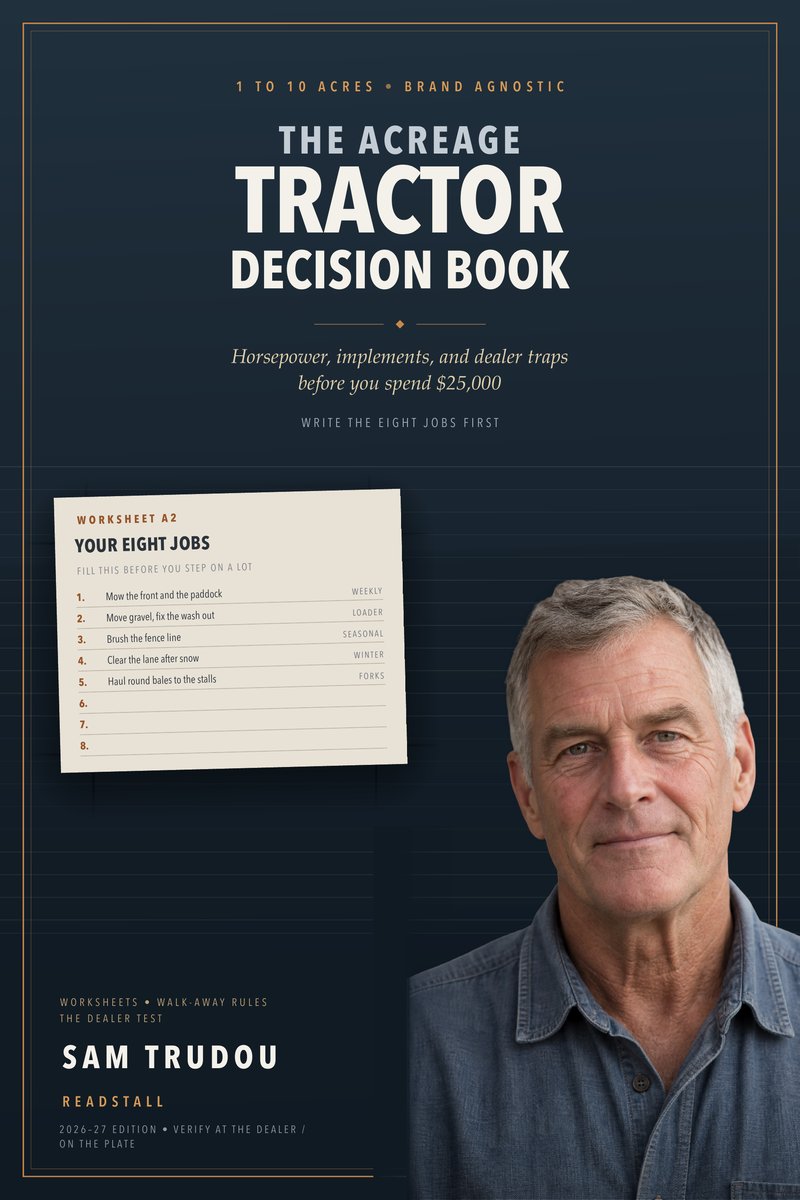
AcreageTractorBook.com · Videos
Tractor Dealer Test Before You Buy: Parts Counter, Demo, Saturday Call
 From Sam Trudou's video27 September 2026
Most buyers test the tractor and take the dealer on faith, yet in year seven your Saturday depends on whether a person at a parts counter can find your machine by its serial number. Here are five checks that test the dealer in one visit, on one card, before anybody talks price.

This is for one to ten acres, a first diesel and two dealers to choose between, a band the book labels an assumption. What you are buying is a machine plus a counter, for a decade.
What you are up against is not a brand but the answer with nobody's name on it: somebody will be around Saturday, we are pretty good on parts. A real answer has a name, a number and a date on it. Kubota, Deere, Mahindra and LS are examples here, never a team.
Asking is not rude. In 2025, 122,854 new two-wheel-drive tractors under forty horsepower were retailed in the United States, down from 135,101 in 2024, per AEM's December 2025 report: member manufacturers only, lawn and estate tractors included. A large, ordinary class, where a dealer expects to be asked for a demo.
Carry one card with four columns: question, answer as given, who said it, date. Fill it at the counter, in front of him. A dealer who watches you write chooses his words carefully.
Check 1. The demo
Ask for the loader on, a rear implement hooked up, and something to move, then book it and bring your job list.
A lap of the lot is a test drive of a seat. A good answer sounds like a schedule: Tuesday morning, bring boots, the box blade is already on one. A bad answer sounds like a reason: insurance will not let us, it is prepped for delivery. Both may be true, and you still go home never having worked the machine.
Bring your eight jobs from chapter two, each with a verb, a season and a place; eight is the book's working length, marked assumption, not a law. Run the two that fight, such as fine turf weekly against a cutter in a wet corner.
A demo puts you on a moving machine with a loader you have never operated. The dealer's briefing and the operator's manual govern that hour, belt fastened with the roll bar up. A loaded bucket changes how a machine behaves on a slope. Discovery is free on a demo. It is not free in August.
Check 2. The Saturday name
Ask who stands at the parts counter on Saturday, write both names down, then call that number on a Saturday morning.
Not whether they open, but who, by name, will be standing there. A good answer is a person: a first name, most Saturdays, eight to noon, and a second for when the first is off. A bad answer is a system, and none of these looks up your serial while your machine sits in the yard:
- A phone tree
- A portal
- A voicemail checked on Monday
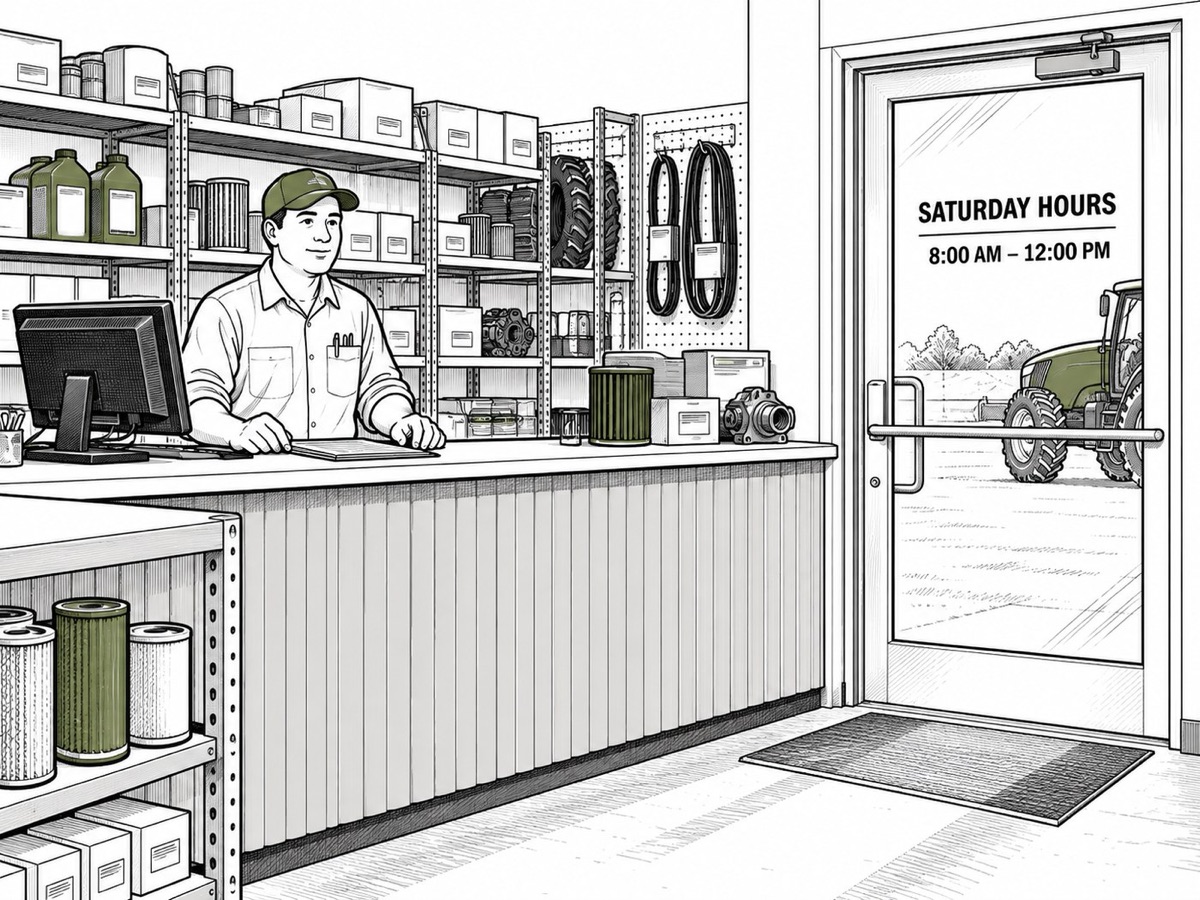
Then make the call. Whoever answers, and how long they take, outranks every word he said across the counter. If nobody picks up, that is your year-seven Saturday, tested for the price of a phone call. I would make that call before I made an offer; it is the one test he cannot prepare for.
Check 3. Two distances
Write miles one way, double it, times your trips in a year, times ten, for this dealer and for the next one.
Both are on a map. Ask him anyway: a dealer who cannot name the next nearest store for his own brand is telling you about his territory. A good answer is unbothered and specific: forty-one miles to the next county, same line, they stock more industrial and we stock more turf. A bad answer is a shrug.
No source the book holds gives a dollar per mile, so it prints none, and nobody has measured the trips either. Write the number you believe, mark it assumption, and correct it after year one.
The hours row is the one people skip. An hour and a half of round trip for one small filter shows up as an afternoon. A man who gives up an afternoon puts the repair off, and a deferred repair breaks at the worst time.
Some trips carry the tractor. Do you own a trailer that will haul it legally, and a truck that will pull it? GVWR, tongue weight and brake requirement come off the trailer's plate; tow and tongue limits come out of the tractor's manual. The BX23S detailed specifications print a maximum tongue weight of 550 pounds and a maximum tow of 1,765 pounds. Read yours, not that one.
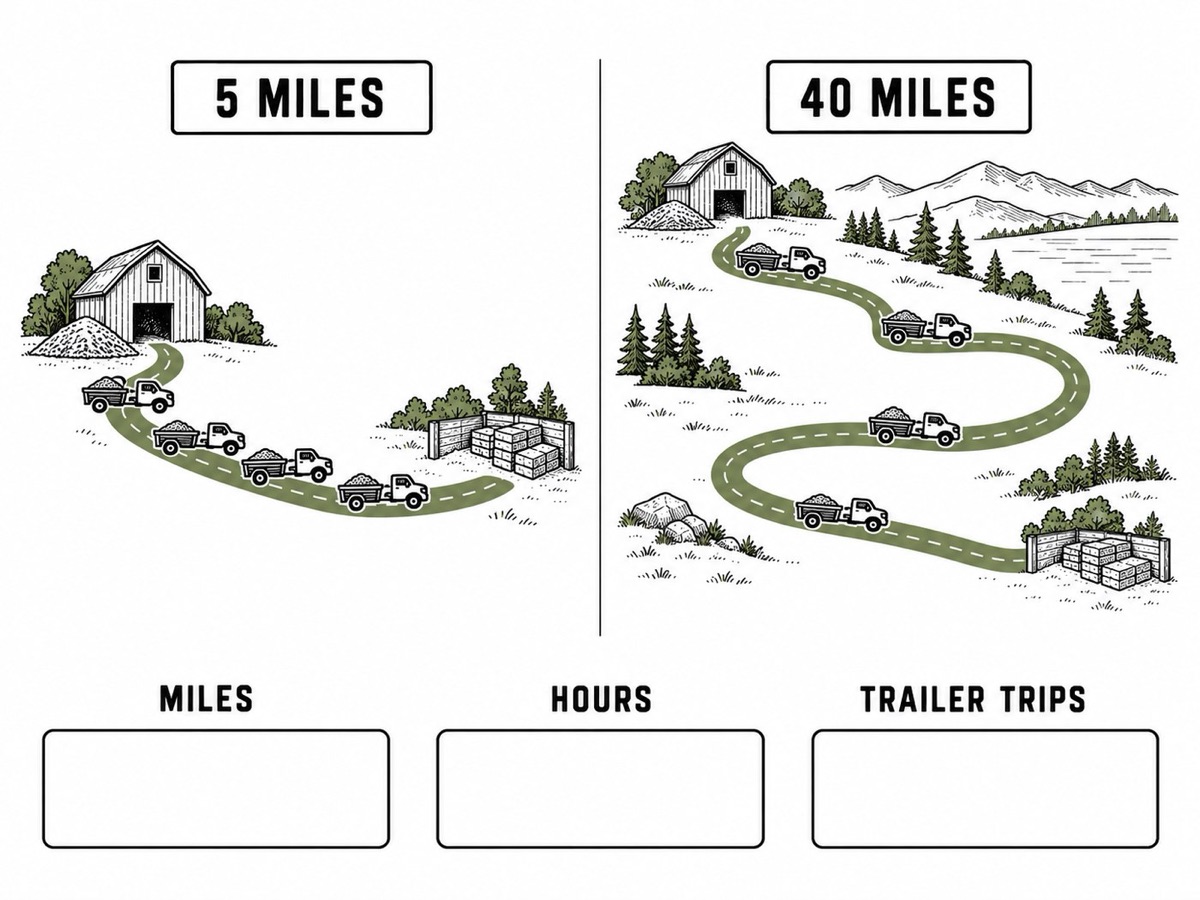
Forty miles is not a drive. It is a line item you pay for ten years.
Check 4. Two sheets, one serial
Ask for the spec sheet and the price sheet for this serial, lay them side by side, and circle every difference.
Not the model, not the brochure, not the web listing: the unit with that plate on it. A good answer is two pieces of paper and a finger pointing at a difference. A dealer who finds his own mismatches for you is the one I would buy from. A bad answer is one sheet doing both jobs.
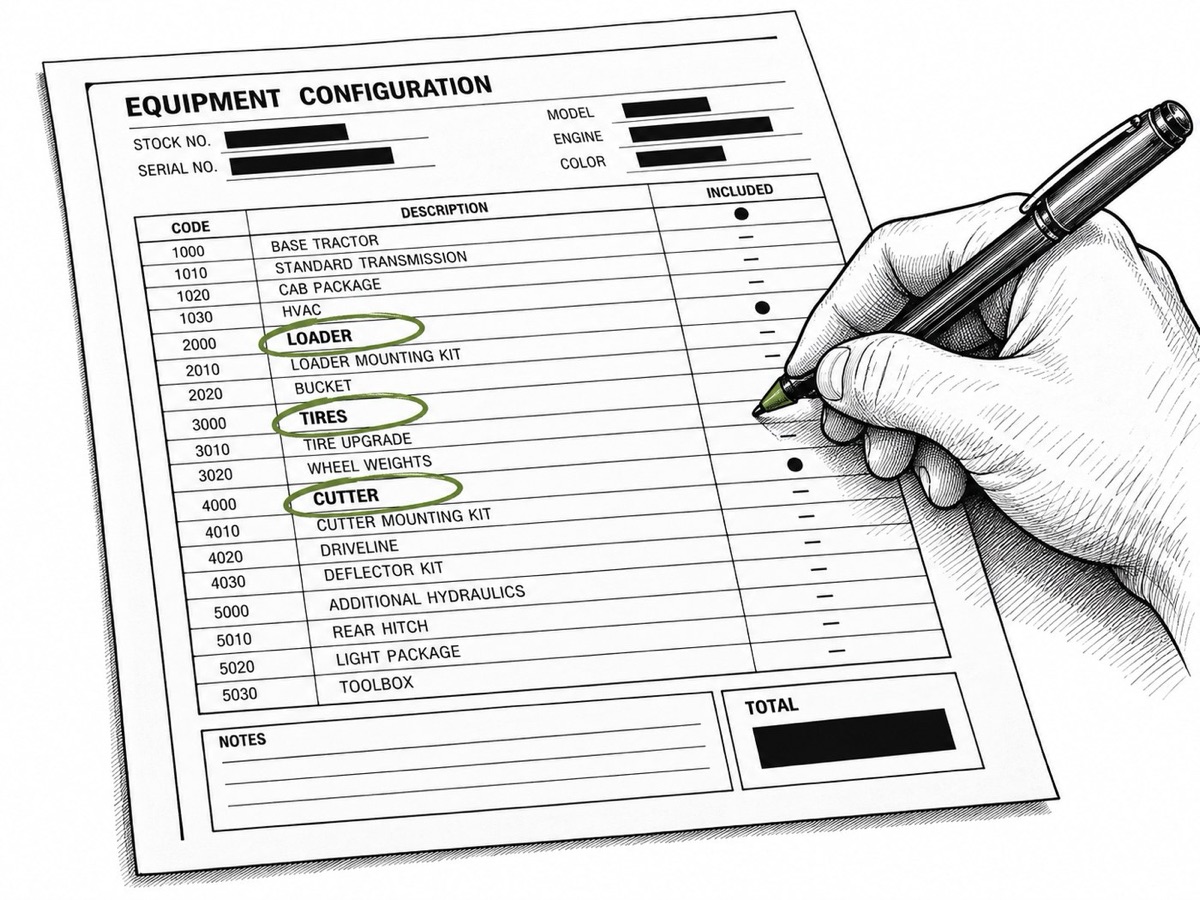
Then price each difference. One in your favor is a bargaining chip. One against you is a line off the quote, or a machine to leave standing. A brochure is a photograph of a class. A build sheet describes the machine you are about to own.
Check 5. The year-seven wait
Name a filter, a pin and a hose, ask for a number of days in year seven, and write his answer down in his words.
This one feels rude. Ask it anyway, and name the parts:
- A fuel filter
- A loader pin
- A hydraulic hose
A good answer is a number with a qualification on it, given without flinching: filters we stock, pins a couple of days from the depot, hoses we make here while you wait. A bad answer is a feeling. We take care of our people is not an answer. Say so, politely, and ask again for a number of days.
I do not know what a good wait is. No source the book holds gives a figure, so it prints none. The only number worth anything is his, with his name and the date beside it. Ask while somebody else is being served, and you see the temper of the place. If he will not give one, leave the line empty. The blank is the finding.