AcreageTractorBook.com · Videos
R1 vs R3 vs R4 Tractor Tires: Mud, Turf, Gravel
 From Sam Trudou's video26 September 2026
Most buyers pick tractor tread by feel, and the lot is happy to pick it for them by printing one set as standard. Here are the five checks that let your own jobs pick R1, R3 or R4 before you sign, and when to walk away.
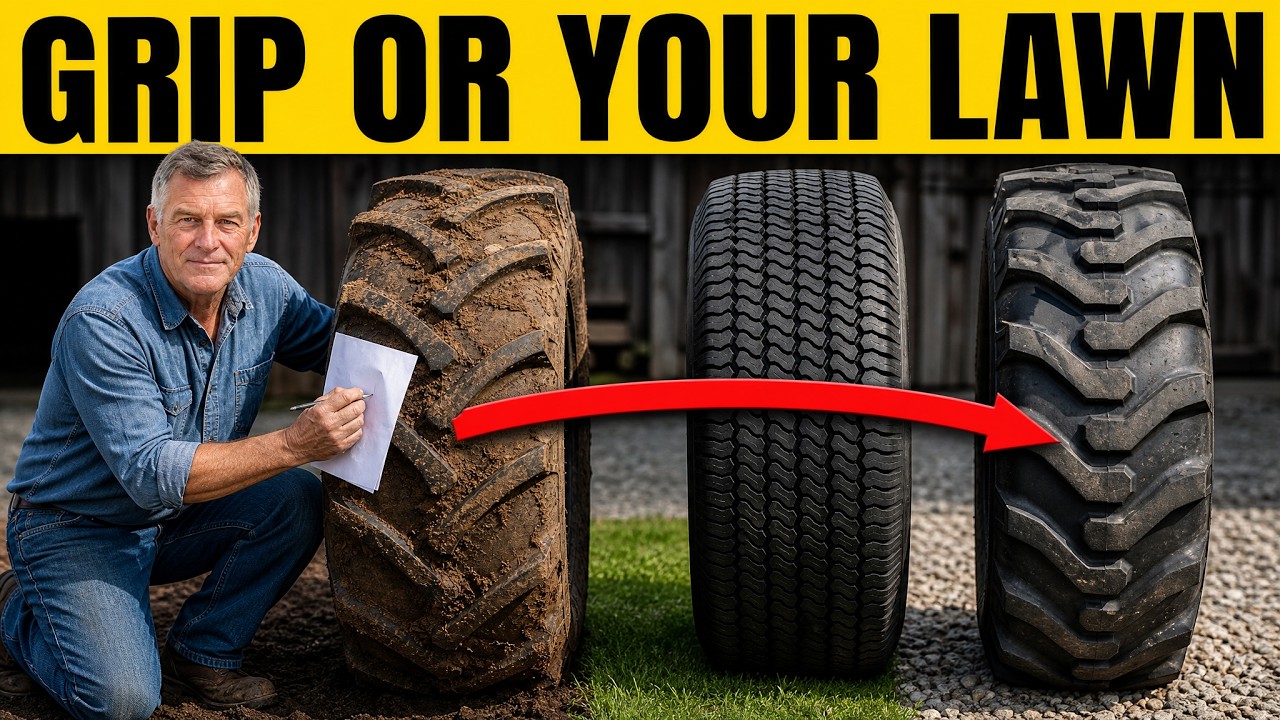
This is for one to ten acres, the band the book is written for and labels an assumption.
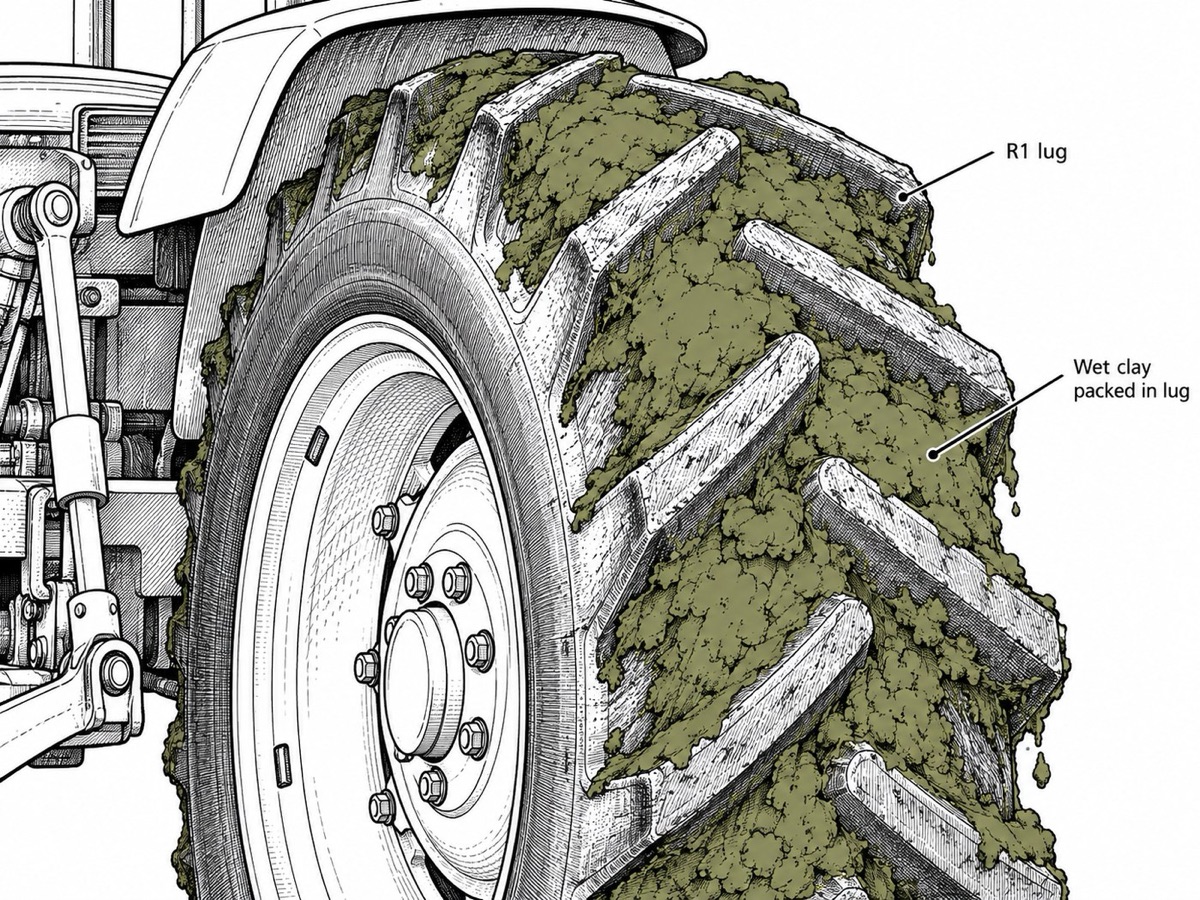
Tires are the cheapest part of the machine to get right at the counter and the most expensive to change your mind about later.
What you are up against is the brochure that picks the tire for you. The machine on the lot wears the tread it was photographed on, the sheet prints standard beside it, and that one word decides eight jobs it has never seen. Standard is a sentence about a photograph. Kubota, Deere, Mahindra, LS and TYM are examples here, never a team.
One sheet settles it: eight job rows down the left, three columns marked mud, turf and gravel, and a total under each. Ten minutes at a kitchen table.
Check 1. The tally
Copy your eight jobs onto the tire sheet, mark each one mud, turf or gravel, then add the three columns.
Eight is the book's working length, and the book labels it an assumption. The three marks mean this:
- Mud: soft, wet or sloped ground where traction decides the job.
- Turf: grass you care about the look of.
- Gravel: a lane, a pad, or loader work.
Snow on a gravel lane is both, so mark it twice. Then read the totals plainly.
- Mud on five of eight is an R1 machine, and you accept torn sod.
- Turf on six of eight is an R3 machine, and you accept that a wet slope stops you.
- Marks spread across all three is the case the industrial tread exists for.
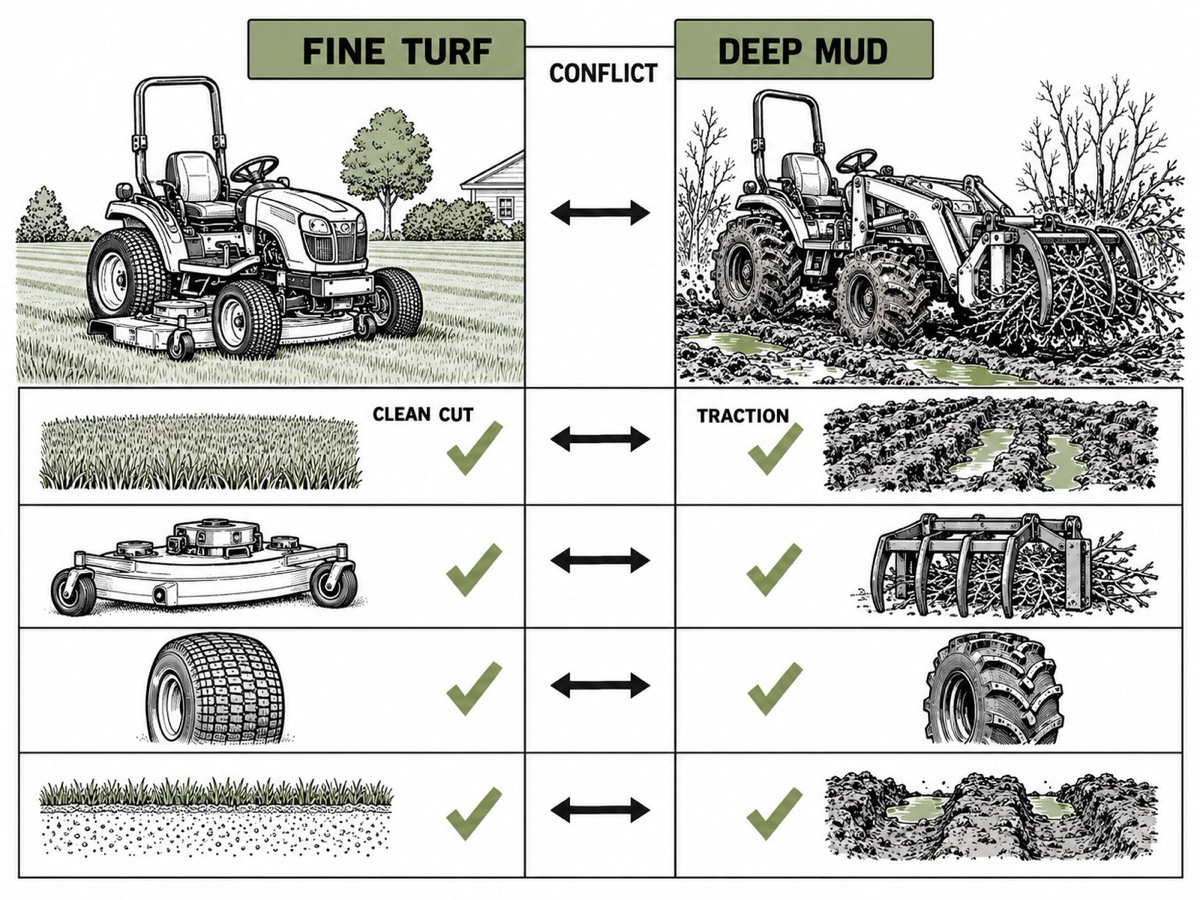
Turf tires on a brush job is a choice, not a failure. If an unmarked lawn is worth a slower pass, take it, and write the trade on the sheet: turf, accepted, will lose traction on the brush job. A trade you wrote down is a plan.
Check 2. What the three codes mean
Write the three codes on the back of your sheet and put beside each one the ground it gives up.
These are tread classes, not quality grades. A higher number is not a better tire, whatever a lot tells you, and every serious maker builds all three. An ASABE continuing education lecture lists the principal drive treads as R1, R1W, R2, R3 and R4.
- R1, agricultural: tall, widely spaced lugs, chosen for soft surfaces. It tears sod and wears fast on gravel and pavement.
- R3, turf: shallow, closely spaced tread. A tire maker's own primer says it clogs in soggy ground and belongs in dry weather.
- R4, industrial: medium-depth lugs on a tougher casing, durable on hard surfaces and, in that primer's words, not the mud tire. R1 beats it in soft dirt, and R3 beats it on a lawn you care about.
A dealer's own buying guide offers a shortcut instead. Serious field work, R1. Lives on the lawn, R3. A bit of everything, R4. That is a dealership explaining its own inventory. The book agrees R4 is the compromise, then labels the claim that most acreage buyers land there an assumption.
Check 3. Read the sidewall
Get down at the rear wheel and copy the whole sidewall string off both axles, letters and all.
Size and R-code are molded into the tire, the only place they are true for the machine in front of you. A used machine may be on its second set.
Watch how two makers write one tire. One subcompact sheet lists front tires 18x8.50-10 and rears 26x12.00-12. Another lists base rears 26x12-12 and fronts 18x8.50-10. That is one rear size in two typing conventions, and a typing difference is not a difference in machines.
The comparison fails on any of these:
- A rear that does not match its partner.
- A size that is nowhere on the sheet.
- Cracking down in the grooves.
Mismatched rears on a four wheel drive machine can bind the drivetrain, and that is a mechanic's question before it is a price question.
If sidewall and sheet disagree, ask what is on the unit and what a change costs, and write the answer down with the name and the date. The sheet says what the factory builds. The sidewall says what came off the truck.
Check 4. Loaded rears
Ask whether the rears are loaded, ask what they hold, and get that answer written onto the quote before you sign.
Fluid ballast lowers the center of gravity and adds traction, and I think it is a sensible thing to do. It also makes a puncture a messy day.
Fluid buys traction. It does not buy permission.
Check 5. The money line
At the counter the salesman tells you turf is standard and industrial is the upgrade. The one manufacturer sheet the book holds that prices both runs the other way.
Find the tire line on your own quote, read whether it says base, a plus, or a number in parentheses, and copy it down.
On a John Deere commercial price page dated 4 November 2022, the 1025R carries R4 industrial as its base tire front and rear, codes 5207 and 6207. The bias-ply R3 turf set is a credit:
- Code 5206 shows $58.00 in parentheses.
- Code 6206 shows $41.00 in parentheses.
Parentheses mean money back, $99.00 your way. The radial-ply R3 set on that page runs the other way: rear 5208 at $149.00, front 6208 at $95.00.
Be careful what that sheet is. It is four model years stale, a government and commercial contract list, one model on one day. It is not your quote and it is not a rule about tire prices. It kills one assumption, that turf is always cheaper. Take the lesson, not the dollars.
Nobody has sourced the rest. No public figure separates what an R1 set costs from an R3 or an R4 across brands, so the book prints none.
Further down that page is a line that costs more than the prices around it. Under chains at $225.89 for 26x12-12 tires, it prints: not compatible with backhoe installed, due to interference with the backhoe subframe. That is not a tire problem, it is a stacking problem. Ask what each box you tick blocks later, in writing.
I read a number in parentheses on a quote before I read the total.