AcreageTractorBook.com · Videos
Subcompact vs Compact Tractor: When a BX Is Too Small
 From Sam Trudou's video21 September 2026
An acre count does not describe the work, however much the dealer talks horsepower. Here are the five checks that decide subcompact, compact, or two machines before you reach the lot, and when to walk away.
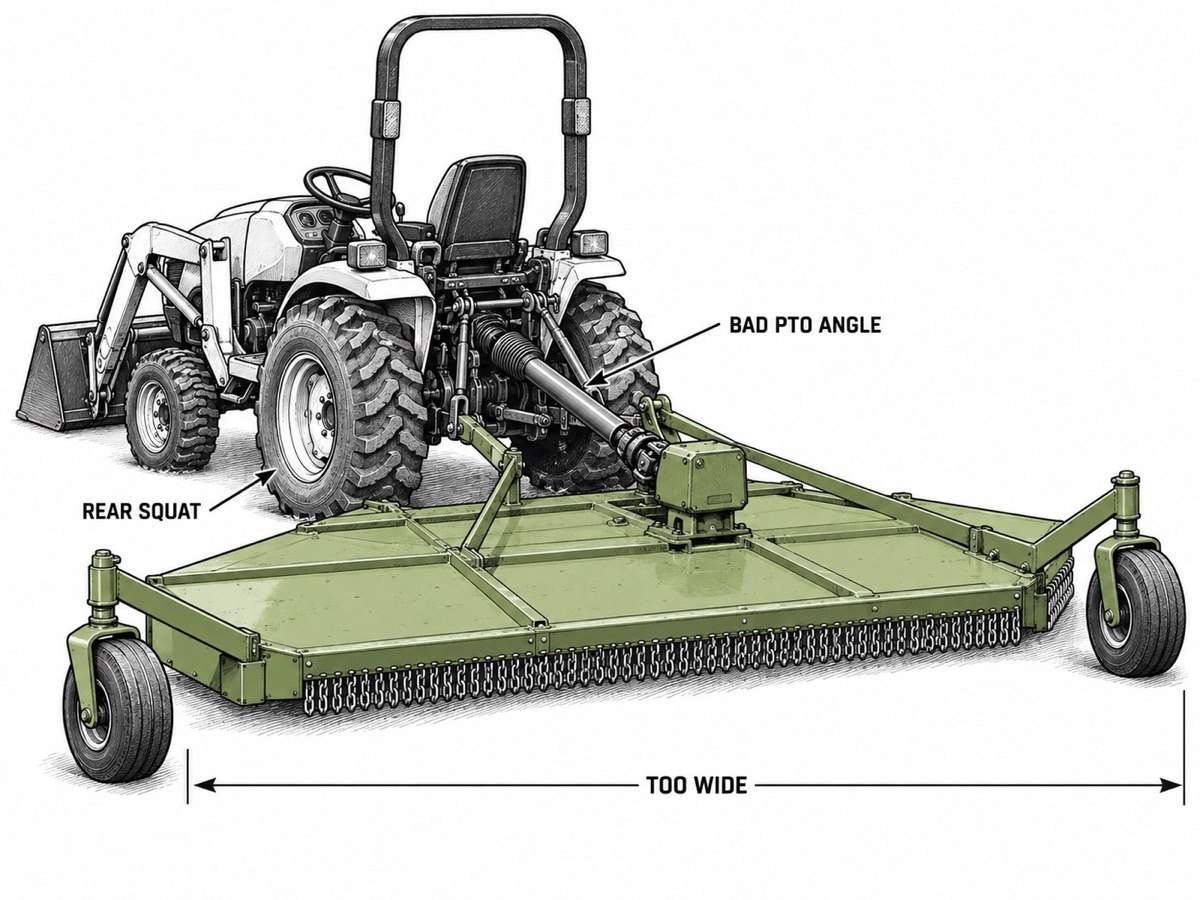
Picture a subcompact with a rotary cutter on its three point, the rear end squatting, the PTO shaft at an angle nobody drew it to turn at. That cutter was sold with the package, not with the job.
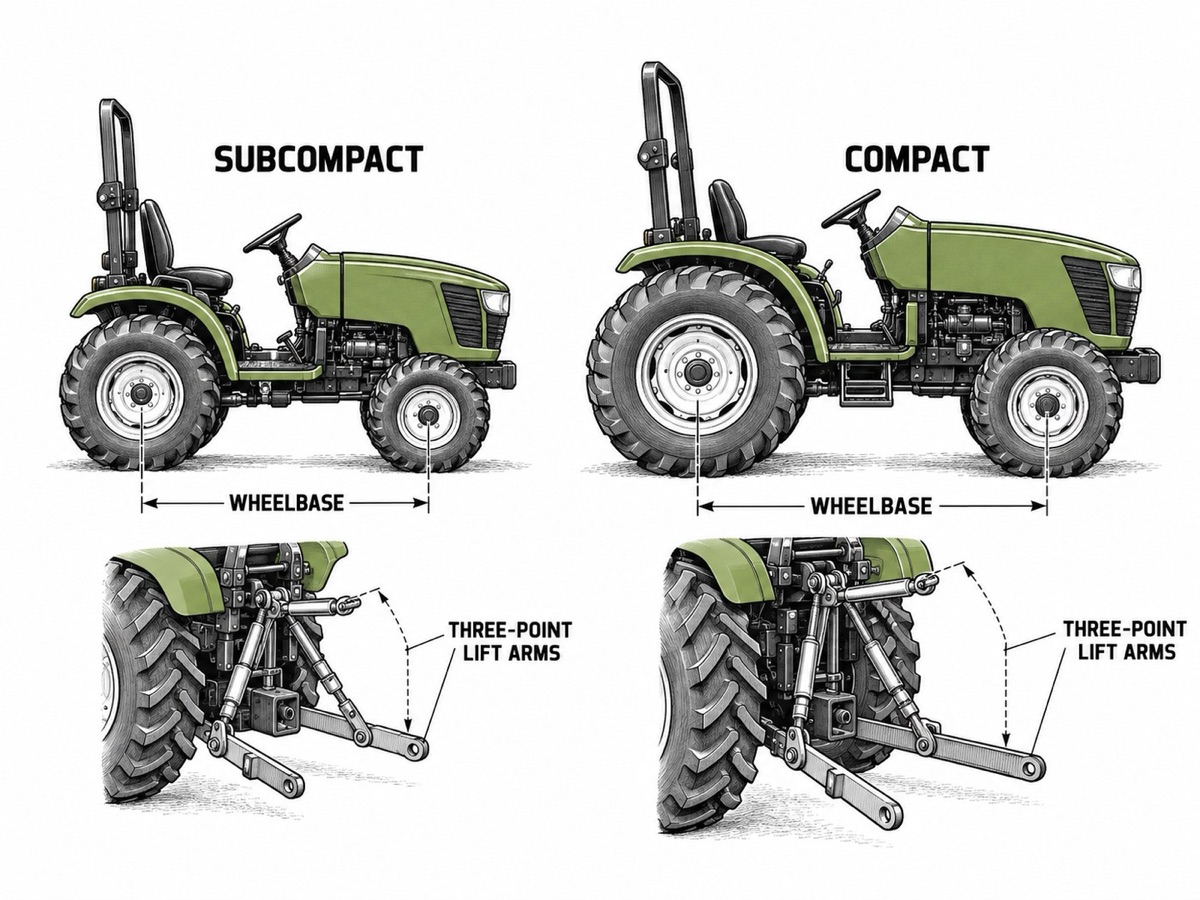
Subcompact and compact are sales words, and nothing on the lot enforces them. The brochure that leads with the smallest machine is not lying to you about horsepower. It picks which number to print large and which one to leave off, and the one it leaves off decides your list. Kubota, Deere, Mahindra, LS and TYM are examples here, never a team.
The Acreage Tractor Decision Book is written against one narrow pattern: on one to five acres, buyers overbuy horsepower and underbuy loader. It labels that an assumption, not a measured rate, and prints no horsepower-per-acre rule anywhere. Its answer is the sizing sheet: five lines, eight rows, three boxes.
Check 1. Split the acres
Split your total into mowed acres, rough or pasture acres, and acres you never touch, then write the longest cutter run.
Six acres with one mowed acre is a one-acre mowing problem. Six acres with five mowed acres is a different machine.
Then the run: the longest stretch you will mow without stopping, and the width of the cutter. That line sizes PTO horsepower, not engine horsepower. A sixty inch finish deck and a sixty inch brush cutter in weeds are not the same load on one driveline. Acres is a number on a deed. Mowed acres is a machine.
Check 2. Name the object and the slope
Name your worst weekly slope and where it is, then name the single heaviest object the loader must lift.
Not the average of the property. The one place you will be every week with a loaded bucket or a full deck. Slope decides tires, ballast, and whether you can carry anything uphill. If you do not know the grade, stand a hundred feet out and see whether the barn roofline sits above your head, then ask the dealer to come and look.
Then the object. One object, named: a pallet of seed, a round bale, a full bucket of wet gravel, heavier than dry gravel and the load that surprises people.
A guessed pound is not a specification. Write the object, then get its weight off the bag, the supplier, or a scale ticket. Everything the loader does for ten years is sized off that line.
Check 3. The second horsepower number
Find the PTO horsepower line on the printed sheet, with its rpm, and compare that number, never the gross engine rating.
Two horsepower numbers live on one machine, and only one talks to your cutter. On the BX23S sheet the engine is rated 21.6 horsepower at 3200 rpm under SAE J1995, and the PTO is rated 17.7 horsepower at 3200 rpm. Two tests, one machine. The cutter only ever meets the second one. Window stickers advertise the first.
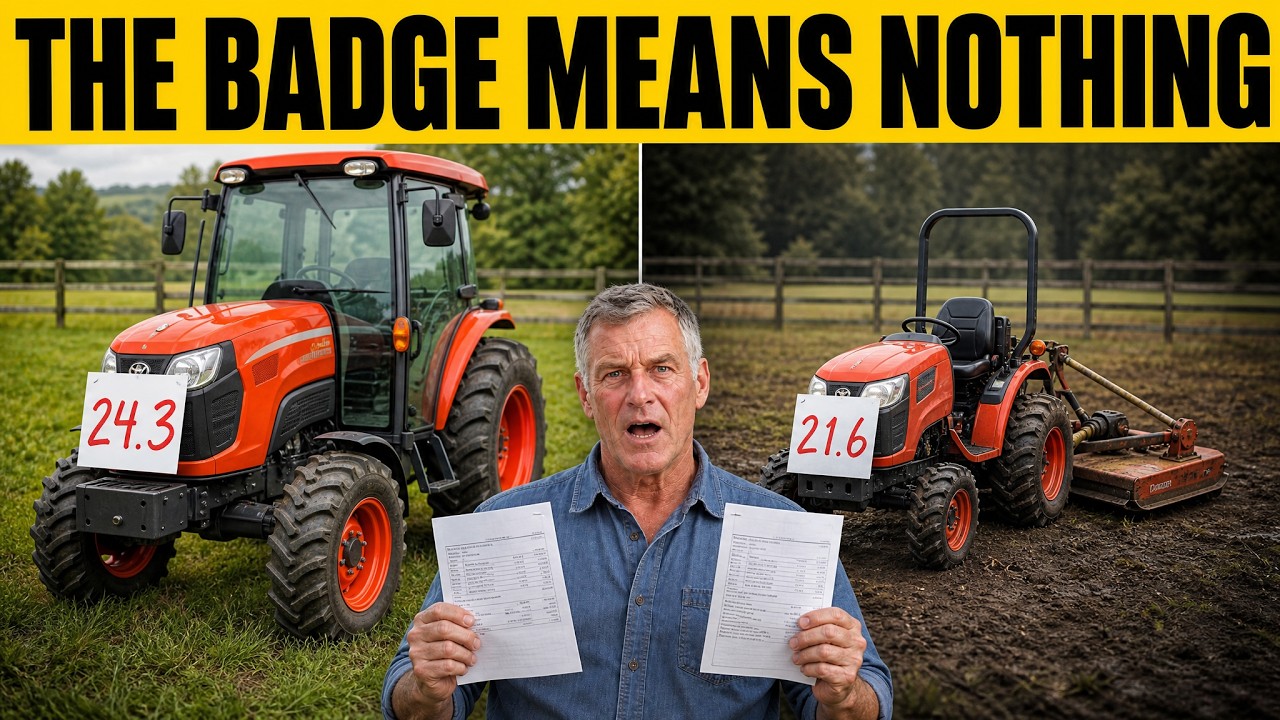
Now the badge. Kubota's own catalogue puts the B01 series under the heading Compact, and the B2601 tile in it lists 24.3 horsepower. The BX23S, which the same company calls a sub-compact, is rated 21.6. That compact tile prints no three point lift figure at all, and rear lift is what you feel with a cutter on the back. Under three horsepower and a word: that is the whole distance between those two names.
All of that is a product page as of September 2026, not a dated printed sheet, so you still copy the rows at the dealer. I read the PTO line before I read the badge, every time. So stop reading badges. Copy rows.
Check 4. The eight rows
Copy eight rows off the printed sheet for every machine on your short list, and write the model year on your own page.
- Gross engine horsepower with its rpm, which decides nothing
- PTO horsepower with its rpm
- Hitch category, SAE Category 1 on the BX23S sheet
- Three point lift
- Rear PTO speed and spline
- Front and rear tire size
- Travel speed in high range
- Brakes and rollover protection
Row four I copy first, and it is two numbers, never one. On the BX23S sheet it reads 1,213 pounds at the lift points and 680 pounds twenty four inches behind them. Your implement hangs out behind the pins, so the second number is the honest one.
Rows nine and ten are operating weight and loader lift capacity. The book leaves them blank on purpose, because the digital file will not line those labels up with their values. Copy them off paper yourself, with the model year on it. If two machines fill those rows identically, the class name on the hood is decoration.
Check 5. One box, three answers
Read your five lines against the rows you copied, then tick exactly one box: subcompact, compact, or two machines.
Box A, stay subcompact. The five lines came back small: little mowed acreage or a separate mower, a gentle slope, a short cutter run, a heaviest lift that is a bucket of material. Buy it, and spend the difference on the loader and on ballast.
Box B, step up. Any one of these four is enough, and you do not need three.
- The cutter is wider than the PTO rating will pull in real conditions.
- The heaviest lift is a bale or a pallet.
- The slope is steep enough that weight and wheelbase decide whether you go up it loaded.
- Row four will not carry an implement you already own.
Box C, two machines. Several mowed acres and real loader work, and every machine that does both well is either too big for the barn door or costs more than the two together. The fifth line forces it: a belly deck needs a mid PTO and a factory fit, and taking it on and off around loader work is a weekly chore.
A price will not tick the box for you. As of September 2026, one subcompact series page listed MSRP as low as $28,061. A different brand's subcompact was listed at one dealer at $23,610 starting, and at another, with a loader and quick coupler fitted, at $31,599 against an MSRP of $33,485. Verify at the dealer. Those last two are the same model class, and the difference is what is bolted to it. Eight thousand dollars of spread inside one class, and not a dollar of it is size.
Ticking the third box is a result, not a failure. That is the sheet working.