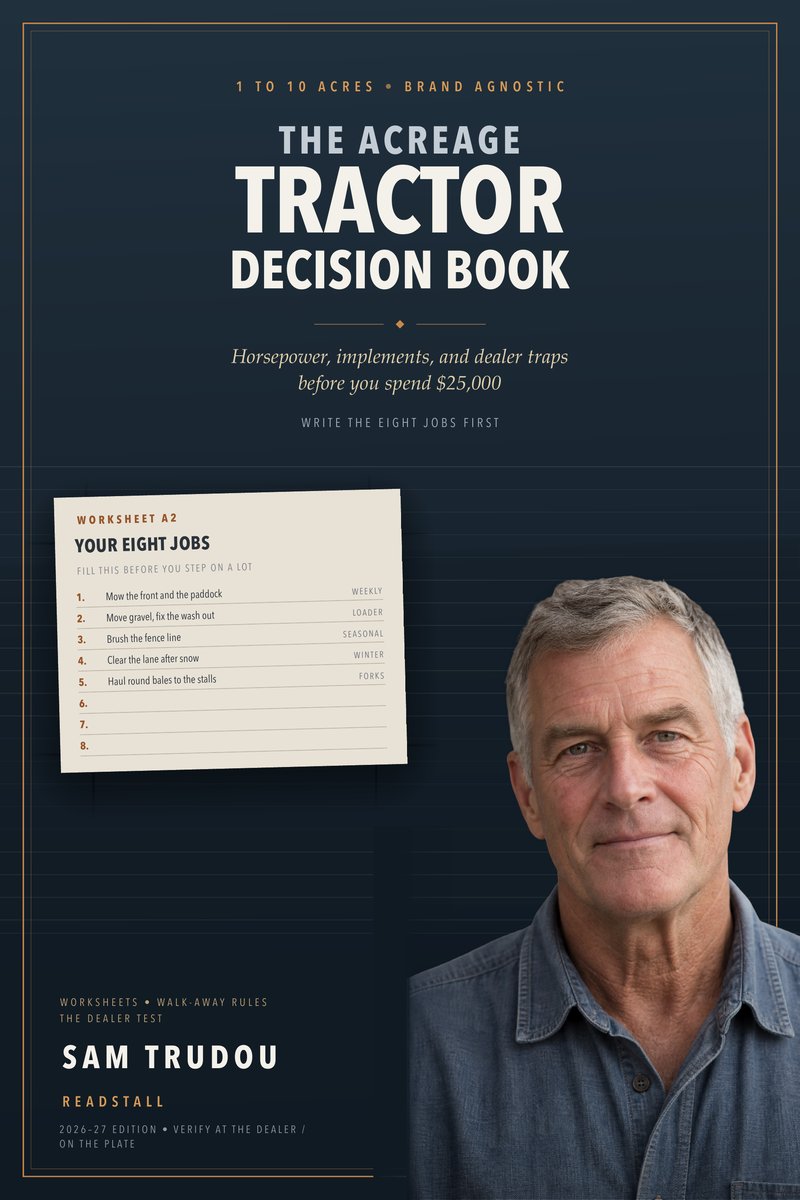
AcreageTractorBook.com · Videos
What Size Tractor Do I Need? Write These 8 Jobs First
 From Sam Trudou's video19 September 2026
Arrive at the dealer without a list and the lot answers the size question for you. Here are the five checks that turn eight written jobs into a tractor, and when to walk away.
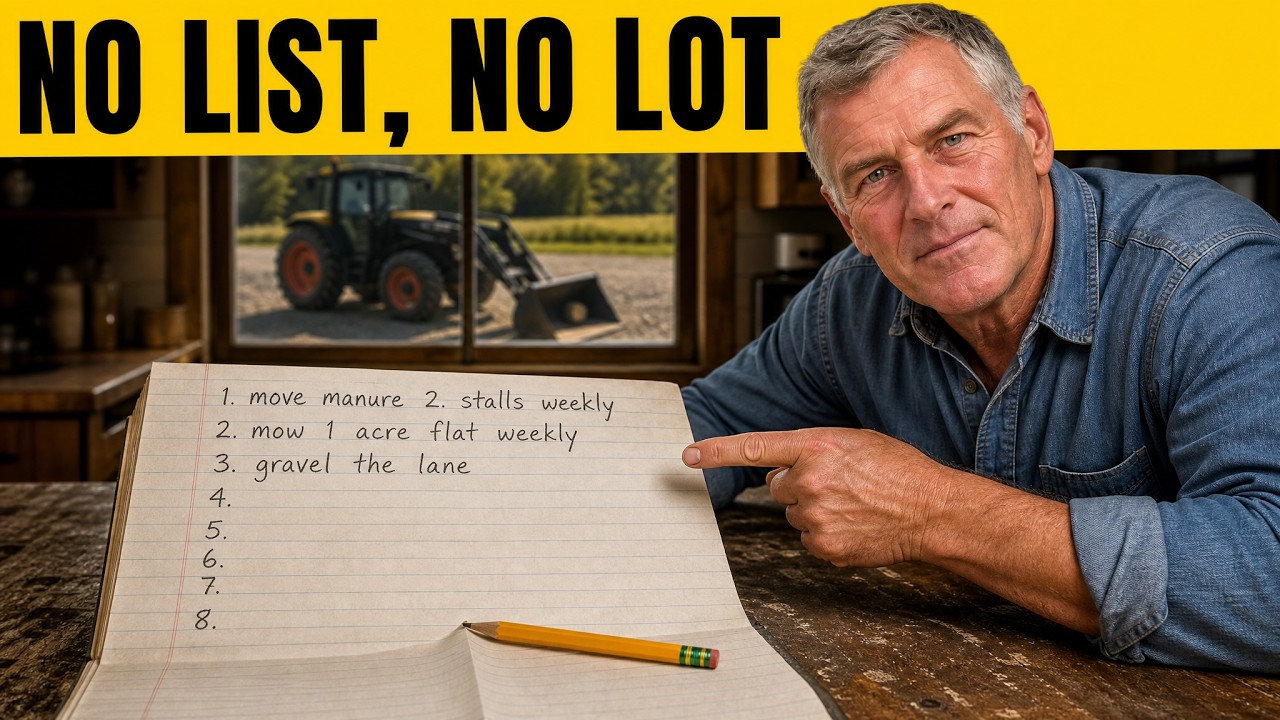
One sheet of paper, eight lines long, written in pencil at your own table, is the only part of this purchase nobody can sell you. The job list picks the tractor.
This is for you if you have one to ten acres, no diesel yet, and a dealer visit on the calendar. One maker's own product page for this class prints that same band, so it is at least how the industry thinks. It is not a law.
Ten feet onto the gravel, someone in a clean shirt asks what you are looking at, and a model name comes out of your mouth. You have picked a machine in four seconds, before one word about your ground.
What you are up against is the package on the lot, not a brand: a window sticker with a price printed across the spec lines, handed over as if that bundle were the only way the machine is sold. Kubota, Deere, Mahindra, LS and TYM are examples here, never a team. The sheet of paper is the answer to the sticker.
Check 1. The verb test
Write each line with a verb, a season and a place, then read it aloud the way you would say it to a neighbor.
"Chores" is not a job. "Move manure and bedding out of two stalls, weekly, all year" is a job. The verb says what the machine must do; the frequency says how much it matters.
Three tests keep the page honest:
- Did the work happen last year at all?
- Can you point at where it happens? A job with no location has no terrain.
- Would you pay somebody else to do it?
A line that fails all three is a wish, and a wish on line four becomes a three-point implement still on its pallet in year two. A job has a verb. A wish has a brochure.
Check 2. The six columns
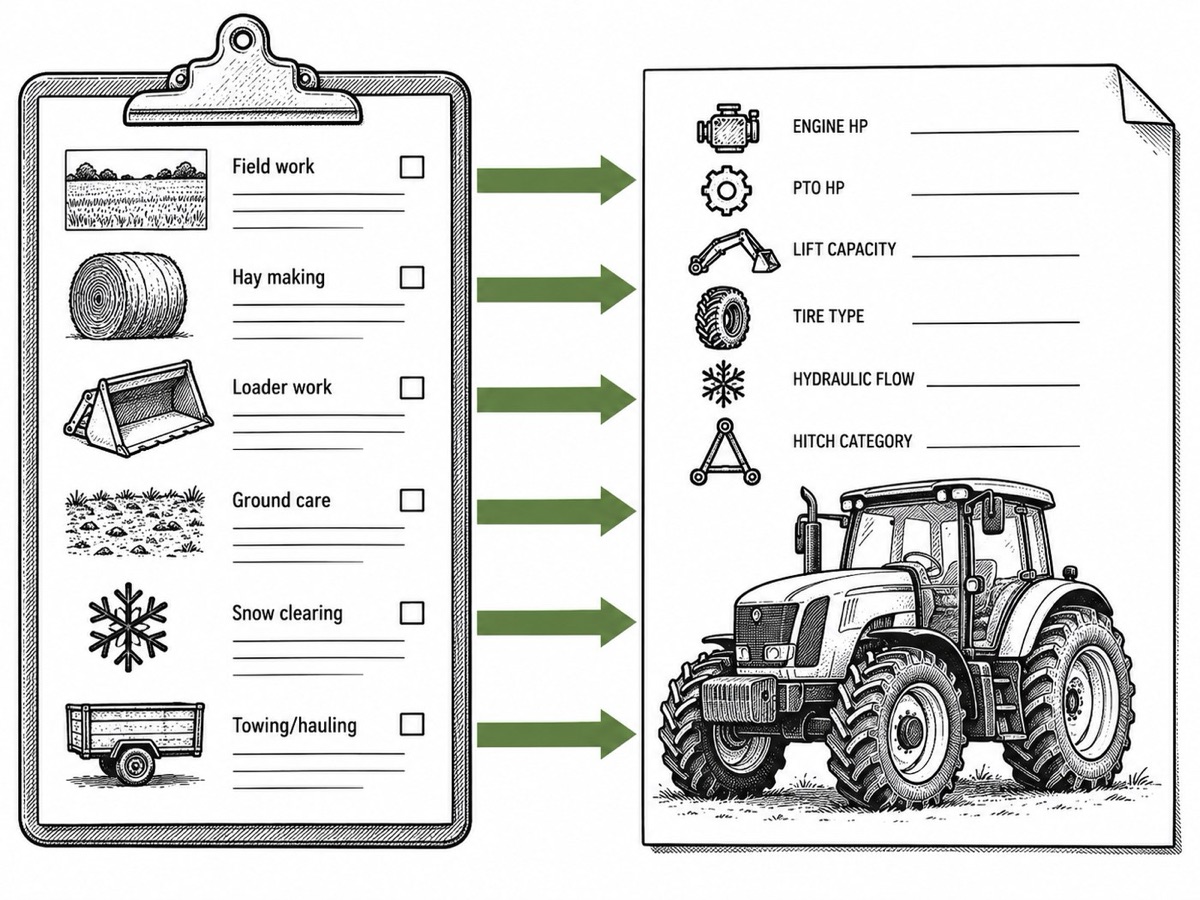
Rule six narrow columns beside your eight lines, and fill the terrain column before you let yourself fill the implement column.
Each job gets six answers:
- The job in your words
- How often
- Acres or hours
- Terrain
- The implement you think you need
- Loader, yes or no
None of them is horsepower. Horsepower does not belong on this sheet.
Terrain is the column people skip, and it decides the tire. An ASABE continuing education lecture lists the principal drive treads as R1, R1W, R2, R3 and R4. A tire maker's own primer says what they are for in plain words:
- R-1 is the agricultural tire, chosen for soft surfaces.
- R-3 turf clogs in soggy ground and belongs in dry weather.
- R-4 is the industrial tire, durable on hard surfaces, and it is not the mud tire.
The word "mud" in that column picks your rubber months before anyone shows you a wheel. Leave it blank and the lot fills it.
Check 3. Count the yeses
Answer loader yes or no on every one of the eight rows, then total the yeses at the bottom of the page.
That total is the single most useful number the worksheet produces. The book's one filled card, for a property that does not exist and labeled an illustration, not a survey, has four of eight jobs moving material: manure, gravel, topsoil, snow. At four out of eight, the loader is the reason for the purchase.
I would not leave that column blank. The loader is the biggest single line item on the quote, and a blank hands the decision to someone paid to fill it.
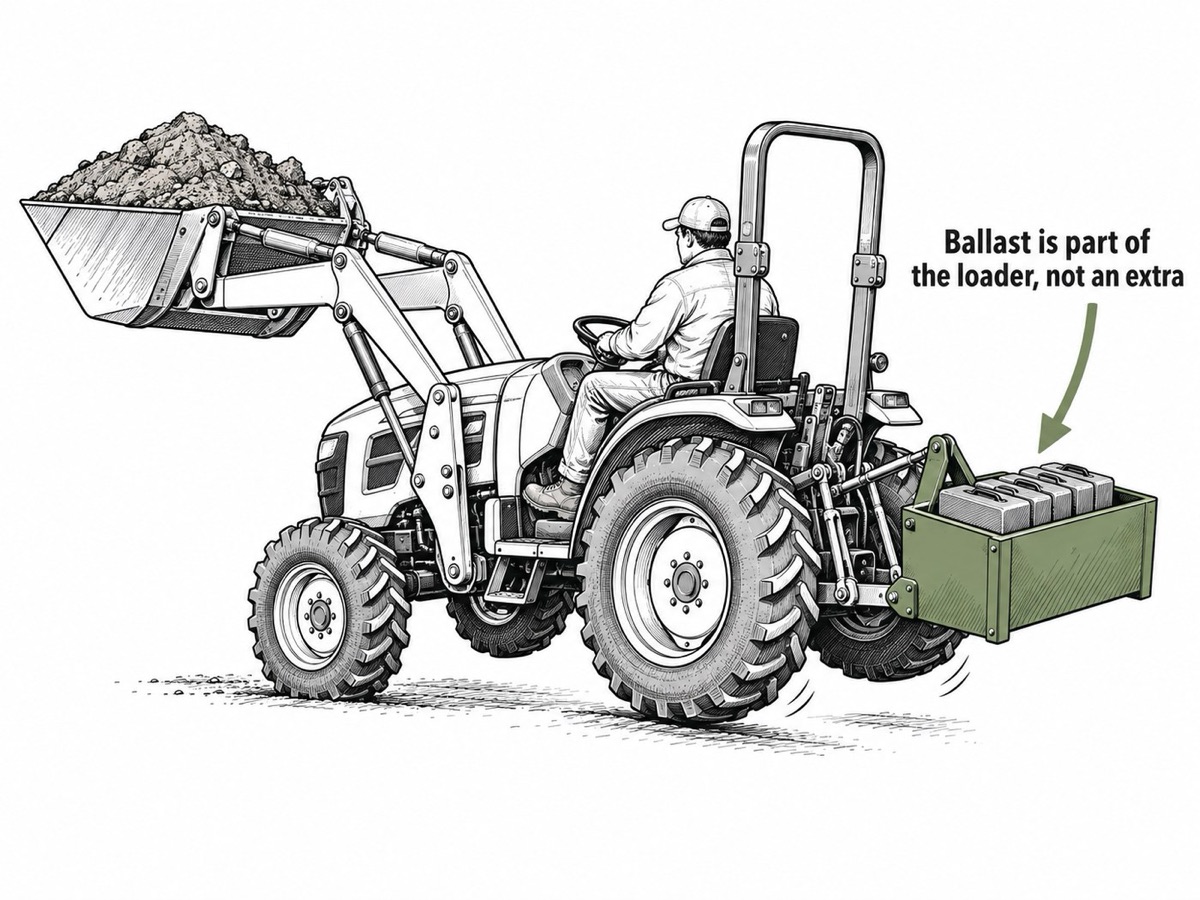
A yes in that column brings a requirement with it. Deere prints it on the loader line of its own commercial price page: "Three-Point Hitch Ballast is Required for Stability." That page is dated 4 November 2022 and is a commercial contract list, quoted for the sentence, not the price. Ballast is the manufacturer's requirement, not an upsell.
Check 4. The two jobs that fight
Read the eight rows as one page and mark any two whose terrain or implement one machine, set up one way, cannot serve.
Eight honest lines will argue with each other. The book prints the standard pair:
- Line one: mow one acre of fine turf, weekly, flat, mid-mount deck, loader no.
- Line six: cut two acres of rough in a wet low corner, seasonally, mud and slope, rotary cutter, loader no.
The tread that will not tear line one's grass is not the tread that holds line six's hill in June, and a finish deck is not a brush cutter.
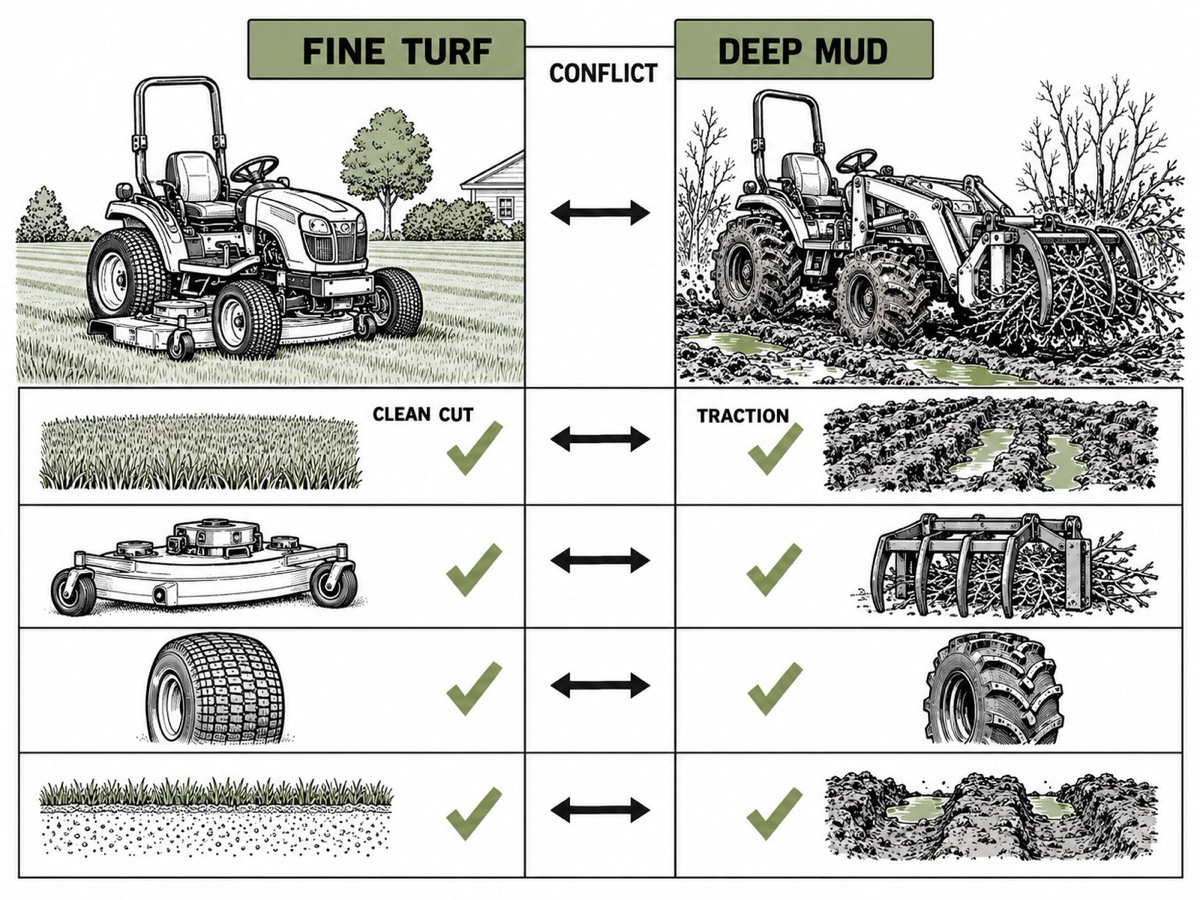
There are three honest answers, and none of them ranks above the others:
- Keep both and take a compromise, which is what one dealer's buying guide means by "If it does a bit of everything, R4." That is a dealership describing its own inventory, not a standard.
- Drop one and hire out the rare job.
- Split into two machines, which is a real answer and not a failure.
The lot will offer a fourth: more horsepower. More engine does not make a turf tire hold a wet slope or turn a finish deck into a cutter. You cannot buy your way out of a tire problem with an engine.
Check 5. Two sentences, two machines
Hand over the folded sheet first, then make the dealer write down whether the number is a starting price or the loaded machine.
Never write the list in front of a salesman; that gets you a list shaped like his inventory. Write it at home and carry it folded.
Then the money, where one model name splits in half. All as of September 2026; verify at the dealer:
- One dealer listed a 2026 John Deere 1025R with a 120R loader and quick coupler at a dealer price of $31,599 against an MSRP of $33,485.
- Another listed a 2026 1025R at $23,610 starting.
- Kubota's own page carried the BX23S at MSRP as low as $28,061.
- Dealer ads for 2026 units of the BX23S showed $28,206 and $29,315.
That gap is not a loader price. The $28,061 is a package price: the BX23S is the factory tractor, loader and backhoe, so both are inside the number. The $23,610 is a bare tractor. Two kinds of number wear the same dollar sign, and three ads are three ads, not a market.
I read a pair of lines like that twice before comparing. Never put a starting price next to a machine with a loader on it.
Eight is the book's working length, labeled an assumption in print; six honest lines beat eight padded ones. Find the rows that fight in pencil at your table, not in August on a wet slope.